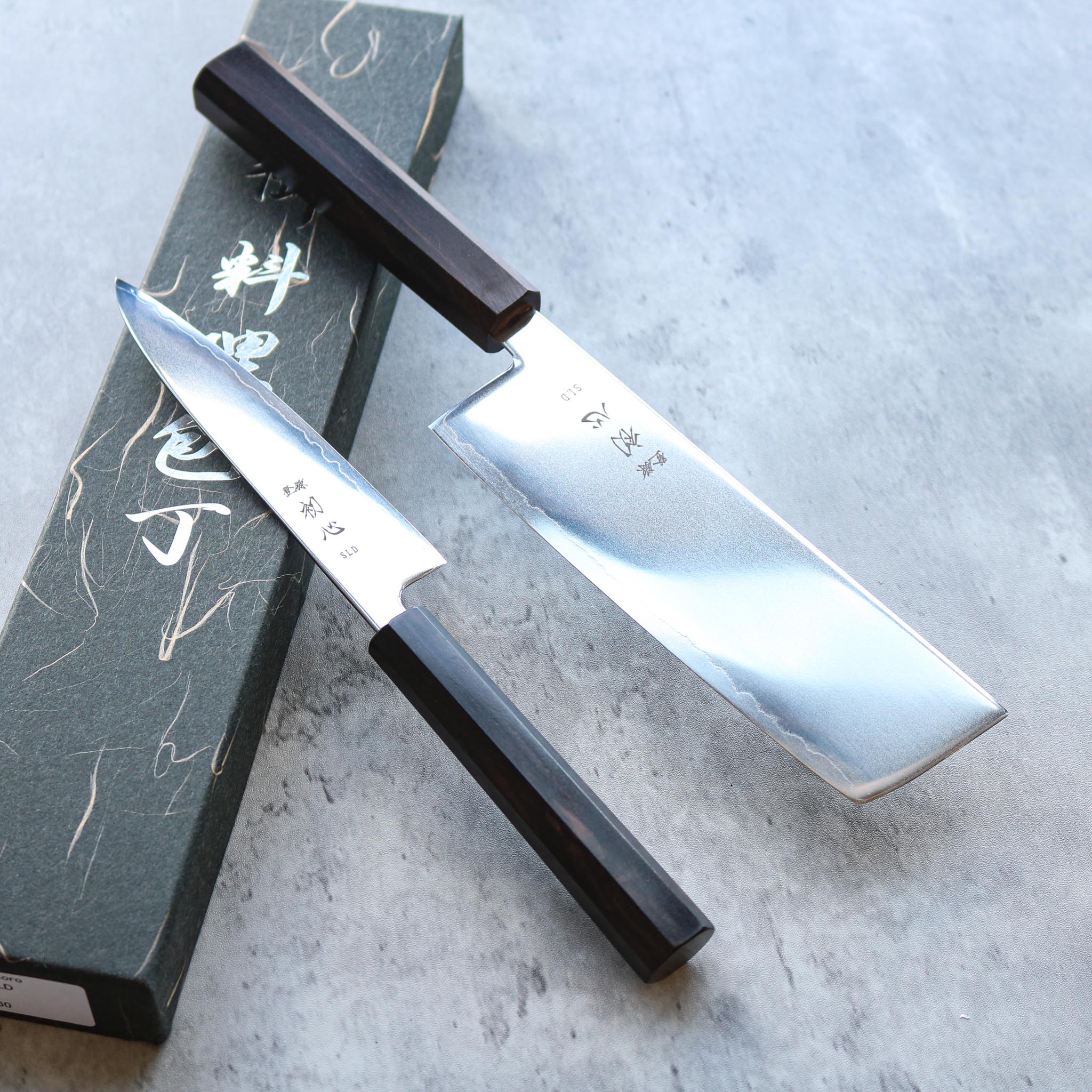
Hatsukokoro Ginrei Petty + Santoku
For more information on the knives included in this set click the links below :
Hatsukokoro Ginrei Petty 135 mm
Hatsukokoro Ginrei Santoku 165 mm
The Blacksmith
Hatsukokoro are masters of smithing, sharpening, and handle making. They ensure quality and a high attention to detail on their knives, so you know that you will be getting an amazing work knife. Based out of the industrial city of Amagasaki, Hyogo Prefecture, Japan, Hatsukokoro offers a wide breadth of handcrafted blades, sourcing from a variety of knife making regions across Japan. Their offerings are diverse in price point and profile, making them a great option for both industry professionals and home cooks.
These knives are relatively thin at the spine and quite thin behind the edge. This gives them a great cutting feel, but we don't find these knives to be particularly delicate, which makes them a great knife to start out your collection with, or for a high volume professional that needs a steel that is both corrosion resistant, and easy to sharpen.
The Knife
The petty knife is the Japanese equivalent of a utility knife. They typically range in size from 90 mm (3.5 inches) to 150 mm (6 inches) and have a slender, easy-to-control, short blade. They are a perfect accompaniment to a Gyuto, Santoku, or Bunka, as they facilitate smaller tasks. Shorter versions are great for in-hand use. Longer versions are great for fine chopping and managing small ingredients on a cutting board. They also handle butchery tasks with ease.
The word "Santoku" translates to "three virtues" and refers to slicing, dicing, and chopping, or meat, fish, and vegetables, depending on who you ask. The name highlights the extreme versatility of the shape, which is why we recommend it most to home cooks. Santokus are typically in the 165 mm (6.5 inch) to 180 mm (8 inch) length range. They generally have a gentle curve that sweeps up toward the tip, so they can easily be used with an up and down chopping motion or a rocking motion.
Knife Care (Semi-Stainless Steel) W/ stainless cladding
- Although this knife is made from semi-stainless steel, and we do still encourage our customers to keep their knives as dry and clean as possible, It also has a stainless cladding which makes its maintenance requirements more in line with a normal stainless steel knife. It's quite easy to care for but can still patina and change colour, even rust when really poorly treated.
- NO DISHWASHER - the high heat will ruin the wooden handle and damage the blade over time.
- Wash and dry by hand using regular dish soap and warm water using a none abrasive sponge or cloth.
- Ensure the knife is dry before being put away for storage and ensure the edge of the knife is protected to avoid any unnecessary dulling.
- Avoid Bones, Frozen foods, nuts and hard candies or anything other than fruits, vegetables and proteins.
- Should any rust form it can be removed using a rust eraser or a mixture of Baking soda and water to simply scrub it clean.
Product Information
Product Information
Shipping & Returns
Shipping & Returns
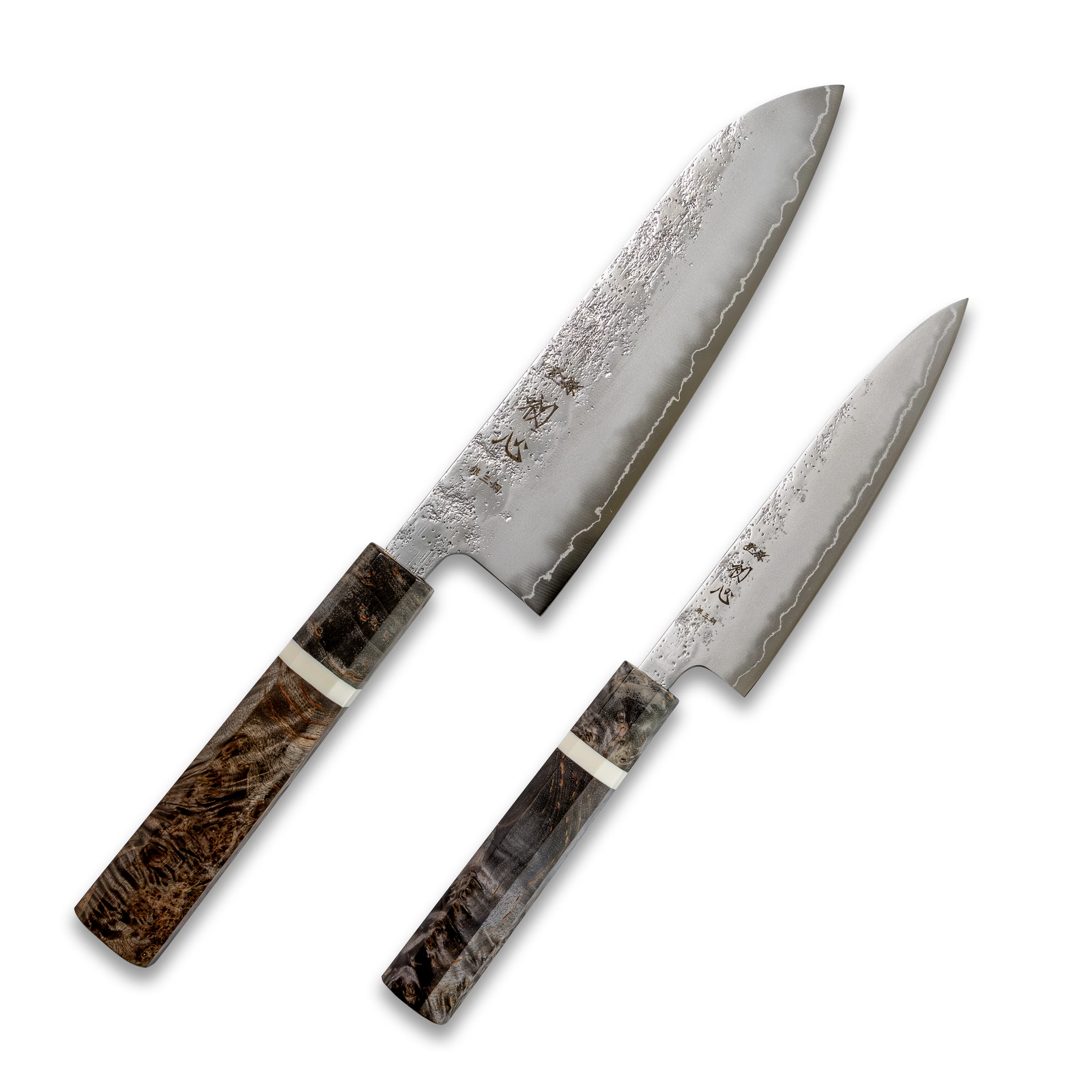
Hatsukokoro Ginrei Petty + Santoku
Hatsukokoro Ginrei Petty + Santoku
For more information on the knives included in this set click the links below :
Hatsukokoro Ginrei Petty 135 mm
Hatsukokoro Ginrei Santoku 165 mm
The Blacksmith
Hatsukokoro are masters of smithing, sharpening, and handle making. They ensure quality and a high attention to detail on their knives, so you know that you will be getting an amazing work knife. Based out of the industrial city of Amagasaki, Hyogo Prefecture, Japan, Hatsukokoro offers a wide breadth of handcrafted blades, sourcing from a variety of knife making regions across Japan. Their offerings are diverse in price point and profile, making them a great option for both industry professionals and home cooks.
These knives are relatively thin at the spine and quite thin behind the edge. This gives them a great cutting feel, but we don't find these knives to be particularly delicate, which makes them a great knife to start out your collection with, or for a high volume professional that needs a steel that is both corrosion resistant, and easy to sharpen.
The Knife
The petty knife is the Japanese equivalent of a utility knife. They typically range in size from 90 mm (3.5 inches) to 150 mm (6 inches) and have a slender, easy-to-control, short blade. They are a perfect accompaniment to a Gyuto, Santoku, or Bunka, as they facilitate smaller tasks. Shorter versions are great for in-hand use. Longer versions are great for fine chopping and managing small ingredients on a cutting board. They also handle butchery tasks with ease.
The word "Santoku" translates to "three virtues" and refers to slicing, dicing, and chopping, or meat, fish, and vegetables, depending on who you ask. The name highlights the extreme versatility of the shape, which is why we recommend it most to home cooks. Santokus are typically in the 165 mm (6.5 inch) to 180 mm (8 inch) length range. They generally have a gentle curve that sweeps up toward the tip, so they can easily be used with an up and down chopping motion or a rocking motion.
Knife Care (Semi-Stainless Steel) W/ stainless cladding
- Although this knife is made from semi-stainless steel, and we do still encourage our customers to keep their knives as dry and clean as possible, It also has a stainless cladding which makes its maintenance requirements more in line with a normal stainless steel knife. It's quite easy to care for but can still patina and change colour, even rust when really poorly treated.
- NO DISHWASHER - the high heat will ruin the wooden handle and damage the blade over time.
- Wash and dry by hand using regular dish soap and warm water using a none abrasive sponge or cloth.
- Ensure the knife is dry before being put away for storage and ensure the edge of the knife is protected to avoid any unnecessary dulling.
- Avoid Bones, Frozen foods, nuts and hard candies or anything other than fruits, vegetables and proteins.
- Should any rust form it can be removed using a rust eraser or a mixture of Baking soda and water to simply scrub it clean.
Original: $217.79
-65%$217.79
$76.23Product Information
Product Information
Shipping & Returns
Shipping & Returns
Description
For more information on the knives included in this set click the links below :
Hatsukokoro Ginrei Petty 135 mm
Hatsukokoro Ginrei Santoku 165 mm
The Blacksmith
Hatsukokoro are masters of smithing, sharpening, and handle making. They ensure quality and a high attention to detail on their knives, so you know that you will be getting an amazing work knife. Based out of the industrial city of Amagasaki, Hyogo Prefecture, Japan, Hatsukokoro offers a wide breadth of handcrafted blades, sourcing from a variety of knife making regions across Japan. Their offerings are diverse in price point and profile, making them a great option for both industry professionals and home cooks.
These knives are relatively thin at the spine and quite thin behind the edge. This gives them a great cutting feel, but we don't find these knives to be particularly delicate, which makes them a great knife to start out your collection with, or for a high volume professional that needs a steel that is both corrosion resistant, and easy to sharpen.
The Knife
The petty knife is the Japanese equivalent of a utility knife. They typically range in size from 90 mm (3.5 inches) to 150 mm (6 inches) and have a slender, easy-to-control, short blade. They are a perfect accompaniment to a Gyuto, Santoku, or Bunka, as they facilitate smaller tasks. Shorter versions are great for in-hand use. Longer versions are great for fine chopping and managing small ingredients on a cutting board. They also handle butchery tasks with ease.
The word "Santoku" translates to "three virtues" and refers to slicing, dicing, and chopping, or meat, fish, and vegetables, depending on who you ask. The name highlights the extreme versatility of the shape, which is why we recommend it most to home cooks. Santokus are typically in the 165 mm (6.5 inch) to 180 mm (8 inch) length range. They generally have a gentle curve that sweeps up toward the tip, so they can easily be used with an up and down chopping motion or a rocking motion.
Knife Care (Semi-Stainless Steel) W/ stainless cladding
- Although this knife is made from semi-stainless steel, and we do still encourage our customers to keep their knives as dry and clean as possible, It also has a stainless cladding which makes its maintenance requirements more in line with a normal stainless steel knife. It's quite easy to care for but can still patina and change colour, even rust when really poorly treated.
- NO DISHWASHER - the high heat will ruin the wooden handle and damage the blade over time.
- Wash and dry by hand using regular dish soap and warm water using a none abrasive sponge or cloth.
- Ensure the knife is dry before being put away for storage and ensure the edge of the knife is protected to avoid any unnecessary dulling.
- Avoid Bones, Frozen foods, nuts and hard candies or anything other than fruits, vegetables and proteins.
- Should any rust form it can be removed using a rust eraser or a mixture of Baking soda and water to simply scrub it clean.