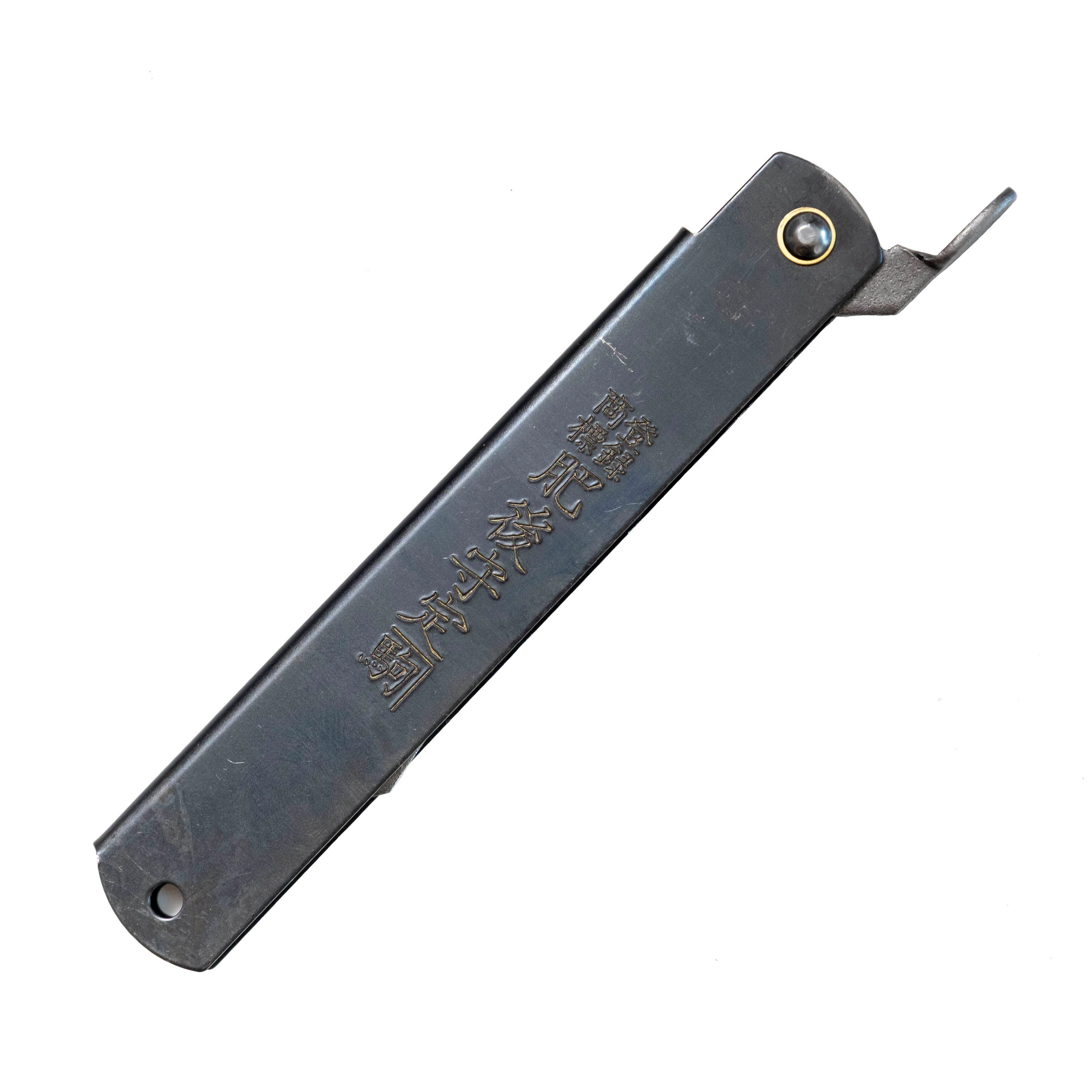
Higonokami Black
| Small Blade Length | 65 mm |
| Small Total Length | 155 mm |
| Medium Blade Length | 75 mm |
| Medium Total Length | 170 mm |
| Large Blade Length | 90 mm |
| Large Total Length | 210 mm |
| Bevel (All Sizes) | Double |
| Steel Type | SK Carbon Steel |
These little pocket knives are super handy and something you'll grow accustomed to having in your pocket rather quickly. We use ours to breakdown boxes, sharpen pencils even cut up fruit and other small vegetables if it's the only thing within reach. They are made from Carbon steel so should be kept as clean and dry as possible. We've included description of the History of Higonokami below taken directly from the Kanekoma website.
"1880's –Mr. Komataro Nagao, our founder, and Mr. Murakami started to produce knives in Hirata, Miki City for the first time.
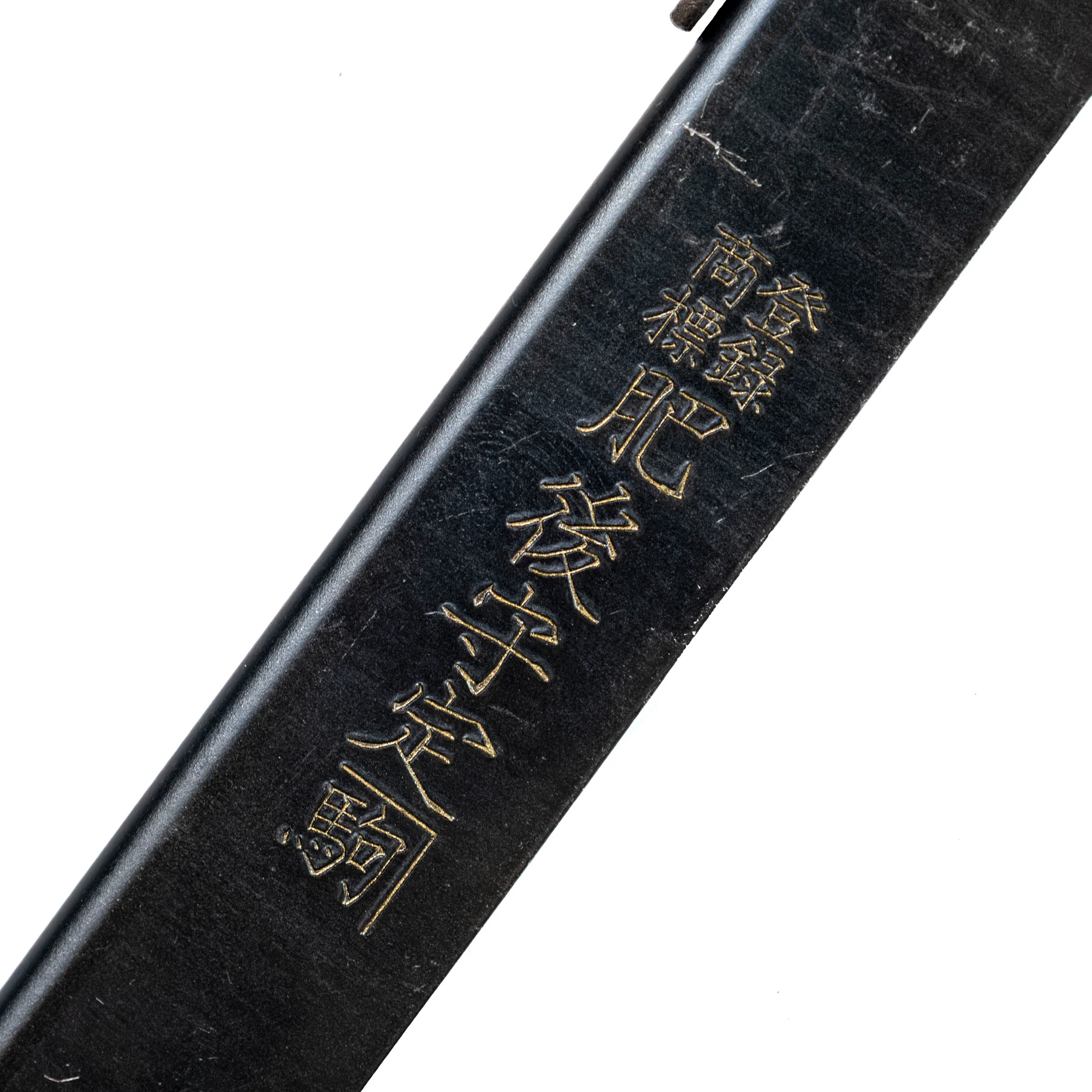
In those days, knives were all made manually. Steel was inserted into iron edge and well forged. The sheaths were made by brass and black-dyed iron plating.
They had on them carvings like portraits, horses, flowers, birds, landscape, etc. One craftsman could only produce 5 to 8 sets a day.
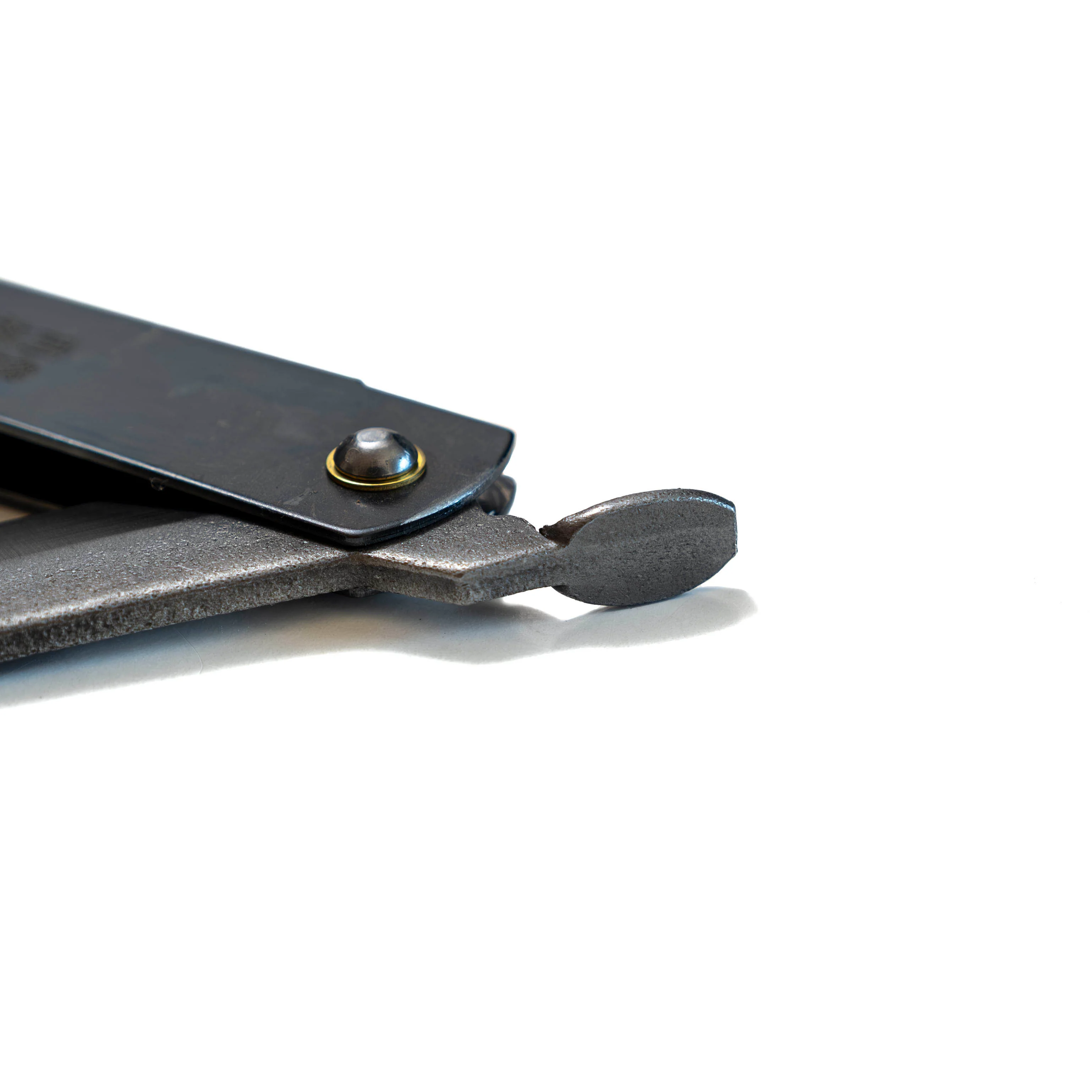
1894- Mr. Tasaburo Shigematsu, a hardware wholesaler, introduced a new pocket knife with its blade and sheath folded by installing a small handle “Chikiri (tail)” on the blade, while inspired by the knife he brought back from Kagoshima. He named it “Higonokami Knife” because many of his customers were in Kumamoto area (formally Higo country), which turned out to dramatically increase his sales.
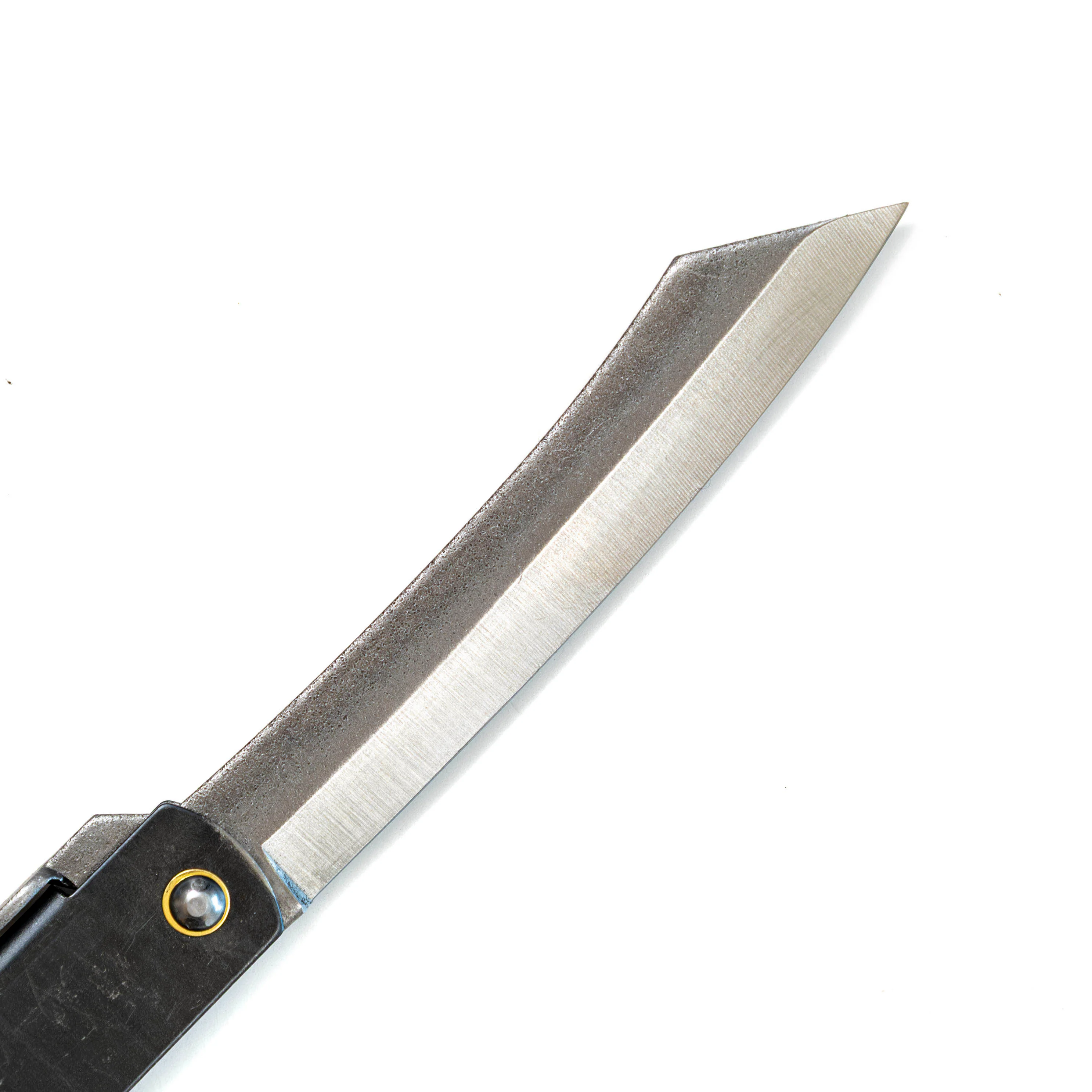
The blades have gradually changed their shapes. Unlike single-edged knives, the double-edged blades (V-shaped cross section) were in those days considered common. The earlier blades had a sharper tip (shape of a bamboo leaf), but now they have square shapes. The sheaths had a vertically folding style and a cross folding style, now the vertical one has to be custom made.
In 1911, at the First Kobe Export Articles Competitive Exhibition, Crown Prince (later Emperor Taisho) liked Higonokami on display very much and bought one, which is said to have helped its fame further spread.
In 1899, "Higonokami Knife Union" was established. In its golden age it had 40 member companies with more than 200 workers in the industry.
However, so many imitations of Higonokami with inferior quality came into the market and caused various problems, which made us decide to obtain a trademark registration of Higonokami in 1910. Thereafter, the use of “Higonokami Brand” became restricted to the members of Miki Knife Manufacturers Association.
Later, the industry was caught up in the tide of the times. The introduction of utility knives and electric pencil sharpeners together with the social campaign against knives in the 1950’s gave the industry a severe blow. More and more manufacturers changed jobs or went out of business and as a result Nagao Kanakoma Knife became the only manufacturer that can use “Higonokami” trademark."
Knife Care (Iron Clad)
- This Knife is made from 3 layers of material; A layer of iron on each side protecting a layer of carbon steel at the core, in a process referred to as Sanmai or forge welding. Iron and carbon steel are both susceptible to rust and must be kept dry and clean at all time’s to avoid oxidation and discolouration.
- Simply wipe the knife with a damp cloth immediately after use.
- Wash with regular dish soap and warm water using a none abrasive sponge or cloth.
- Never put your knife in the dishwasher! The extreme heat will ruin the wooden handle.
- Highly acidic ingredients (Onions, Tomatoes, Citrus) Will cause rust and oxidation to happen faster, thus the user must ensure the knife is wiped clean immediately after working with such an ingredient.
- Should any rust form it can be removed using a rust eraser or a mixture of Baking soda and water to simply scrub it clean.
- Avoid Bones, Frozen foods, nuts and hard candies or anything other than fruits, vegetables and proteins.
Product Information
Product Information
Shipping & Returns
Shipping & Returns
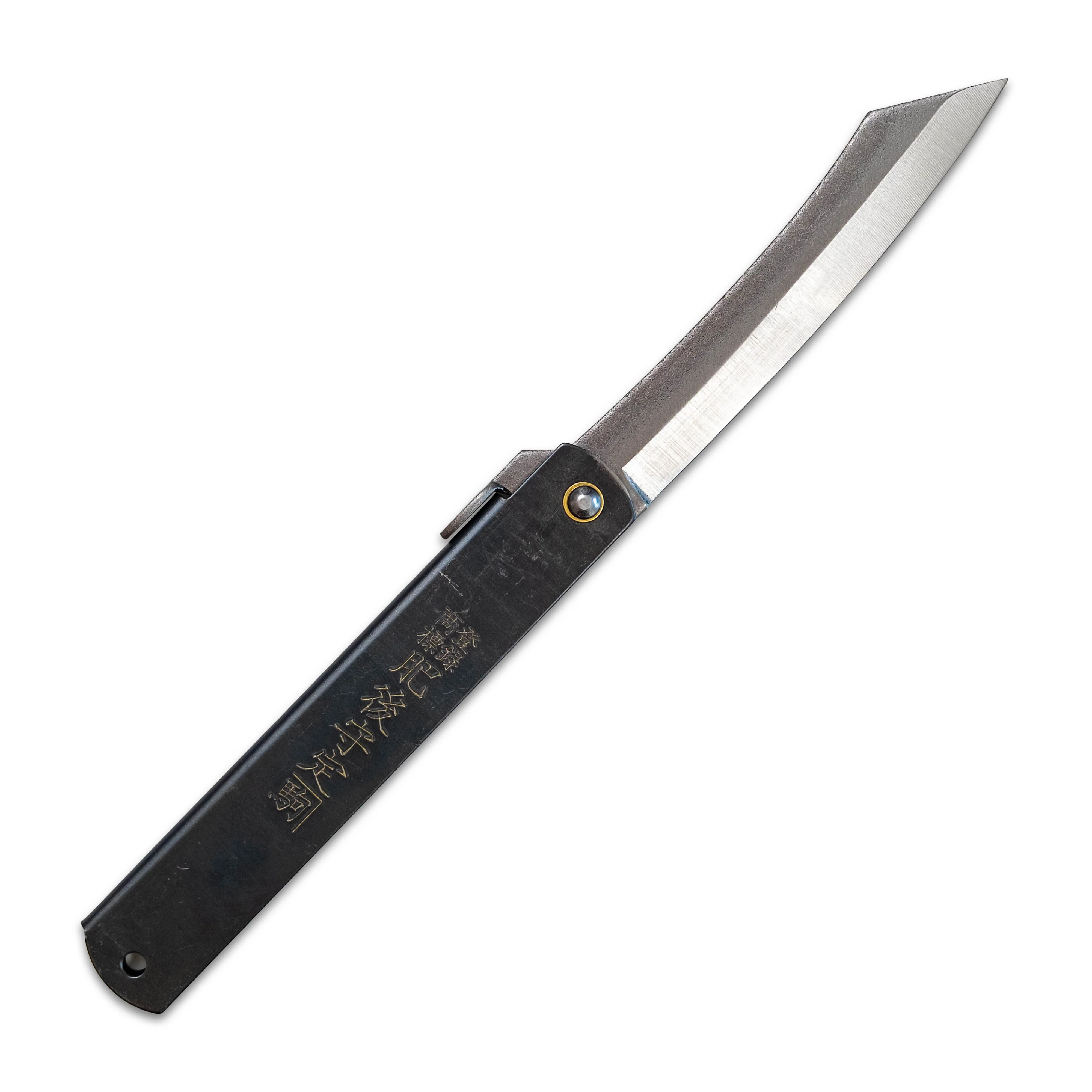
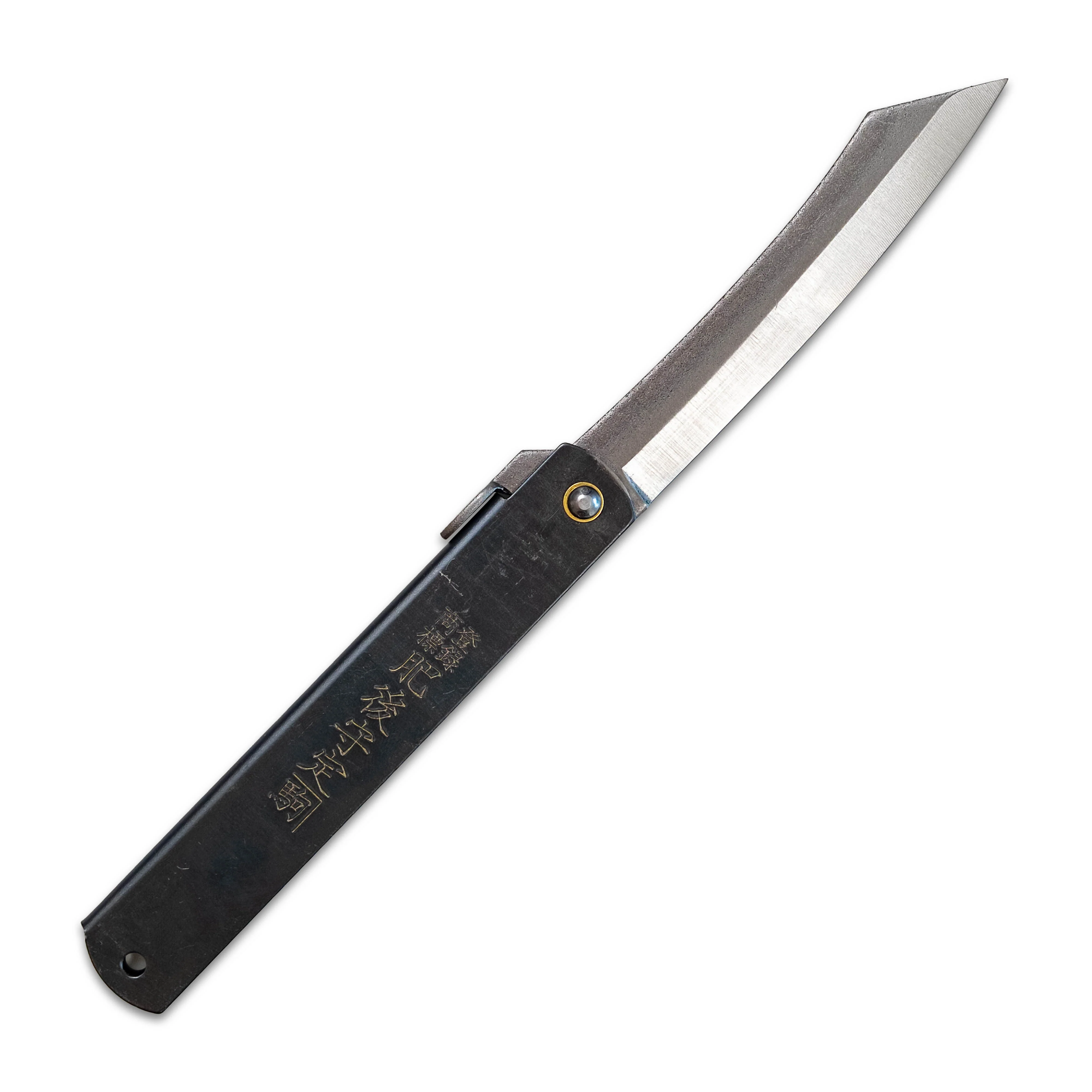
Higonokami Black
Higonokami Black
| Small Blade Length | 65 mm |
| Small Total Length | 155 mm |
| Medium Blade Length | 75 mm |
| Medium Total Length | 170 mm |
| Large Blade Length | 90 mm |
| Large Total Length | 210 mm |
| Bevel (All Sizes) | Double |
| Steel Type | SK Carbon Steel |
These little pocket knives are super handy and something you'll grow accustomed to having in your pocket rather quickly. We use ours to breakdown boxes, sharpen pencils even cut up fruit and other small vegetables if it's the only thing within reach. They are made from Carbon steel so should be kept as clean and dry as possible. We've included description of the History of Higonokami below taken directly from the Kanekoma website.
"1880's –Mr. Komataro Nagao, our founder, and Mr. Murakami started to produce knives in Hirata, Miki City for the first time.
In those days, knives were all made manually. Steel was inserted into iron edge and well forged. The sheaths were made by brass and black-dyed iron plating.
They had on them carvings like portraits, horses, flowers, birds, landscape, etc. One craftsman could only produce 5 to 8 sets a day.
1894- Mr. Tasaburo Shigematsu, a hardware wholesaler, introduced a new pocket knife with its blade and sheath folded by installing a small handle “Chikiri (tail)” on the blade, while inspired by the knife he brought back from Kagoshima. He named it “Higonokami Knife” because many of his customers were in Kumamoto area (formally Higo country), which turned out to dramatically increase his sales.
The blades have gradually changed their shapes. Unlike single-edged knives, the double-edged blades (V-shaped cross section) were in those days considered common. The earlier blades had a sharper tip (shape of a bamboo leaf), but now they have square shapes. The sheaths had a vertically folding style and a cross folding style, now the vertical one has to be custom made.
In 1911, at the First Kobe Export Articles Competitive Exhibition, Crown Prince (later Emperor Taisho) liked Higonokami on display very much and bought one, which is said to have helped its fame further spread.
In 1899, "Higonokami Knife Union" was established. In its golden age it had 40 member companies with more than 200 workers in the industry.
However, so many imitations of Higonokami with inferior quality came into the market and caused various problems, which made us decide to obtain a trademark registration of Higonokami in 1910. Thereafter, the use of “Higonokami Brand” became restricted to the members of Miki Knife Manufacturers Association.
Later, the industry was caught up in the tide of the times. The introduction of utility knives and electric pencil sharpeners together with the social campaign against knives in the 1950’s gave the industry a severe blow. More and more manufacturers changed jobs or went out of business and as a result Nagao Kanakoma Knife became the only manufacturer that can use “Higonokami” trademark."
Knife Care (Iron Clad)
- This Knife is made from 3 layers of material; A layer of iron on each side protecting a layer of carbon steel at the core, in a process referred to as Sanmai or forge welding. Iron and carbon steel are both susceptible to rust and must be kept dry and clean at all time’s to avoid oxidation and discolouration.
- Simply wipe the knife with a damp cloth immediately after use.
- Wash with regular dish soap and warm water using a none abrasive sponge or cloth.
- Never put your knife in the dishwasher! The extreme heat will ruin the wooden handle.
- Highly acidic ingredients (Onions, Tomatoes, Citrus) Will cause rust and oxidation to happen faster, thus the user must ensure the knife is wiped clean immediately after working with such an ingredient.
- Should any rust form it can be removed using a rust eraser or a mixture of Baking soda and water to simply scrub it clean.
- Avoid Bones, Frozen foods, nuts and hard candies or anything other than fruits, vegetables and proteins.
Product Information
Product Information
Shipping & Returns
Shipping & Returns
Description
| Small Blade Length | 65 mm |
| Small Total Length | 155 mm |
| Medium Blade Length | 75 mm |
| Medium Total Length | 170 mm |
| Large Blade Length | 90 mm |
| Large Total Length | 210 mm |
| Bevel (All Sizes) | Double |
| Steel Type | SK Carbon Steel |
These little pocket knives are super handy and something you'll grow accustomed to having in your pocket rather quickly. We use ours to breakdown boxes, sharpen pencils even cut up fruit and other small vegetables if it's the only thing within reach. They are made from Carbon steel so should be kept as clean and dry as possible. We've included description of the History of Higonokami below taken directly from the Kanekoma website.
"1880's –Mr. Komataro Nagao, our founder, and Mr. Murakami started to produce knives in Hirata, Miki City for the first time.
In those days, knives were all made manually. Steel was inserted into iron edge and well forged. The sheaths were made by brass and black-dyed iron plating.
They had on them carvings like portraits, horses, flowers, birds, landscape, etc. One craftsman could only produce 5 to 8 sets a day.
1894- Mr. Tasaburo Shigematsu, a hardware wholesaler, introduced a new pocket knife with its blade and sheath folded by installing a small handle “Chikiri (tail)” on the blade, while inspired by the knife he brought back from Kagoshima. He named it “Higonokami Knife” because many of his customers were in Kumamoto area (formally Higo country), which turned out to dramatically increase his sales.
The blades have gradually changed their shapes. Unlike single-edged knives, the double-edged blades (V-shaped cross section) were in those days considered common. The earlier blades had a sharper tip (shape of a bamboo leaf), but now they have square shapes. The sheaths had a vertically folding style and a cross folding style, now the vertical one has to be custom made.
In 1911, at the First Kobe Export Articles Competitive Exhibition, Crown Prince (later Emperor Taisho) liked Higonokami on display very much and bought one, which is said to have helped its fame further spread.
In 1899, "Higonokami Knife Union" was established. In its golden age it had 40 member companies with more than 200 workers in the industry.
However, so many imitations of Higonokami with inferior quality came into the market and caused various problems, which made us decide to obtain a trademark registration of Higonokami in 1910. Thereafter, the use of “Higonokami Brand” became restricted to the members of Miki Knife Manufacturers Association.
Later, the industry was caught up in the tide of the times. The introduction of utility knives and electric pencil sharpeners together with the social campaign against knives in the 1950’s gave the industry a severe blow. More and more manufacturers changed jobs or went out of business and as a result Nagao Kanakoma Knife became the only manufacturer that can use “Higonokami” trademark."
Knife Care (Iron Clad)
- This Knife is made from 3 layers of material; A layer of iron on each side protecting a layer of carbon steel at the core, in a process referred to as Sanmai or forge welding. Iron and carbon steel are both susceptible to rust and must be kept dry and clean at all time’s to avoid oxidation and discolouration.
- Simply wipe the knife with a damp cloth immediately after use.
- Wash with regular dish soap and warm water using a none abrasive sponge or cloth.
- Never put your knife in the dishwasher! The extreme heat will ruin the wooden handle.
- Highly acidic ingredients (Onions, Tomatoes, Citrus) Will cause rust and oxidation to happen faster, thus the user must ensure the knife is wiped clean immediately after working with such an ingredient.
- Should any rust form it can be removed using a rust eraser or a mixture of Baking soda and water to simply scrub it clean.
- Avoid Bones, Frozen foods, nuts and hard candies or anything other than fruits, vegetables and proteins.